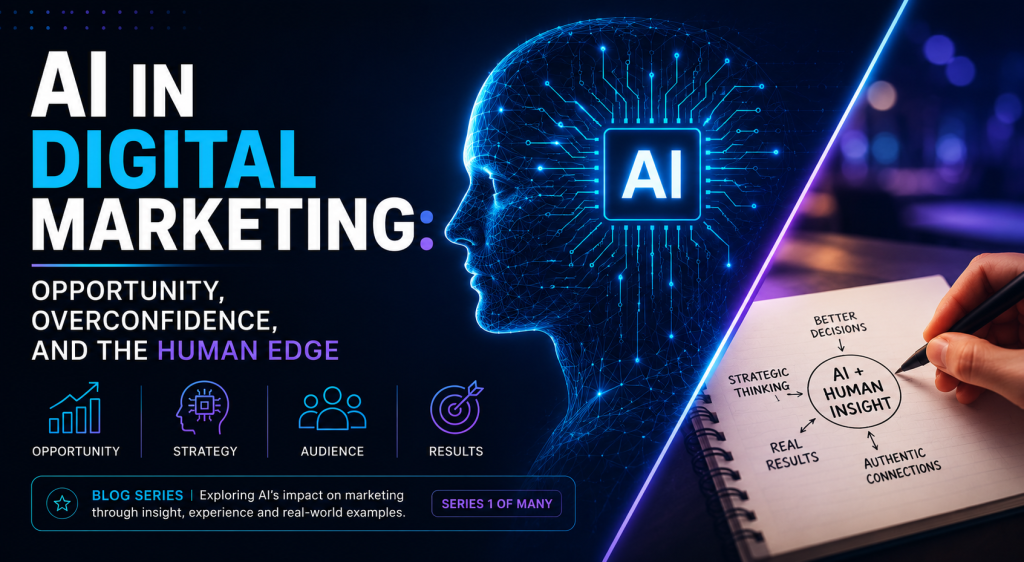

Every marketing agency in the country is fielding the same questions right now. Should we be using AI? Are our competitors using it? Are we falling behind?
The conversation has shifted from “should we adopt AI?” to “how much should we trust it?” – and that’s exactly the right question to be asking.
At MNA Digital, we’ve spent considerable time working through where AI genuinely adds value across website design, SEO, paid search, and social media advertising – and where it can quietly cause problems if left unchecked.
This article is the first in a series designed to give you an honest, grounded view of AI’s role in digital marketing. Not a sales pitch. Not scaremongering. Just a clear-eyed look at what AI can and cannot do – and what happens when businesses forget the difference.
The Numbers Behind the Hype
The scale of AI adoption is hard to ignore. According to research by Exploding Topics, 77% of companies are either using or actively exploring AI, and 83% say it is a top priority in their business plans. The global AI market is projected to contribute $15.7 trillion to the global economy by 2030.
Within marketing specifically, AI tools have proliferated rapidly. From automated ad bidding platforms to AI-generated content, SEO tools that surface keyword gaps in seconds, and website builders that promise a conversion-ready homepage overnight – the options are seemingly endless.
But here is the figure that deserves equal attention: 43% of businesses are concerned about technology dependence. And with good reason.
Speed without strategy creates risk. Automation without oversight creates error. And in marketing, errors do not stay quiet – they spread.
When AI Gets It Wrong: Real-World Lessons
The failures of AI-led marketing are no longer theoretical. They are documented, public, and often costly.
Coca-Cola’s “soulless” Christmas campaign generated widespread backlash. The company’s AI-generated festive advertisement was described by viewers and creatives alike as “soulless,” “lifeless,” and “digital slop.” The emotional warmth that made the original 1995 advertisement iconic was simply absent.
McDonald’s Netherlands faced a similar situation, pulling an AI-generated Christmas advertisement entirely after it was widely described as “soulless.” Disabling the comments only amplified the story.
Deloitte’s hallucinated government reports represent perhaps the most serious cautionary tale. Their Australian member firm submitted a report to the Department of Employment and Workplace Relations that contained fabricated references – including a citation to a non-existent book attributed to a real professor in a field entirely outside her expertise.
The Glasgow Wonka Experience illustrated what happens when AI-generated promotional content has no basis in reality. Families paid for tickets to an event marketed with “dreamlike” AI-generated imagery promising enchanted gardens and candy worlds. What awaited them was a sparsely decorated warehouse with jelly beans and lemonade.
These are not fringe cases. They are the logical consequence of using AI as a substitute for human judgement, rather than a tool that operates within it.
The Flip Side: When AI Is Done Right
It would be dishonest to paint only the negative picture. AI, deployed thoughtfully, produces genuinely impressive results.
Heinz asked an AI image generator to produce images of ketchup, regardless of how the prompt was phrased – every image looked unmistakably like Heinz. The campaign generated over 1.15 billion earned impressions globally, a social media engagement rate 38% higher than previous campaigns, and a return on media investment of 2,500%.
Nutella used an AI algorithm to generate seven million unique jar designs, all sold across Italy. The algorithm operated within strict creative parameters set by human designers – approved colour palettes, pattern types, and compositional rules. The result was a campaign that turned supermarket shelves into art galleries and significantly boosted brand engagement.
H&M created 30 hyper-realistic digital twins of real models, each owning and controlling their digital likeness. Human creative teams collaborated closely throughout, ensuring diversity, individuality, and ethical rigour. The campaign set a new standard for responsible AI use in creative marketing.
The pattern is consistent: successful AI deployment keeps humans in the strategic and creative loop. Failures occur when that relationship is reversed.
What This Means Across the Four Core Areas of Digital Marketing
The implications of AI’s strengths and limitations play out differently depending on which aspect of digital marketing you are looking at. This is something we will explore in depth throughout this series.
The brands that are getting AI right share one defining characteristic: they treat AI as a powerful execution engine guided by human strategic direction. Those that are getting it wrong have reversed that relationship.
At MNA Digital, technology informs and accelerates our work. It does not replace the expertise, the critical thinking, or the human understanding of what makes marketing actually work.
What’s Coming Next in This Series
This article is the beginning of a deeper conversation. Over the coming months, we will be publishing dedicated pieces exploring AI’s role in each of MNA Digital’s core service areas.
Each article will go deeper into the practical realities, the common mistakes, and the smarter approaches that actually drive results.
If you are a business owner or marketing decision-maker trying to work out how AI fits into your strategy – without the hype and without the unnecessary fear – this series is built for you.
Get in touch so we can give tailored advice on how to keep your business moving forward.